New Fire Safety Tools: BS 5839 Wizard, False Alarm Analyser & Emergency Lighting Checklist
Professional utilities for UK fire alarm engineers and electricians — bringing BS 5839 and BS 5266 guidance directly to your pocket for faster, more compliant installations.
Posted: January 2026 | Category: Product Updates, Fire Safety
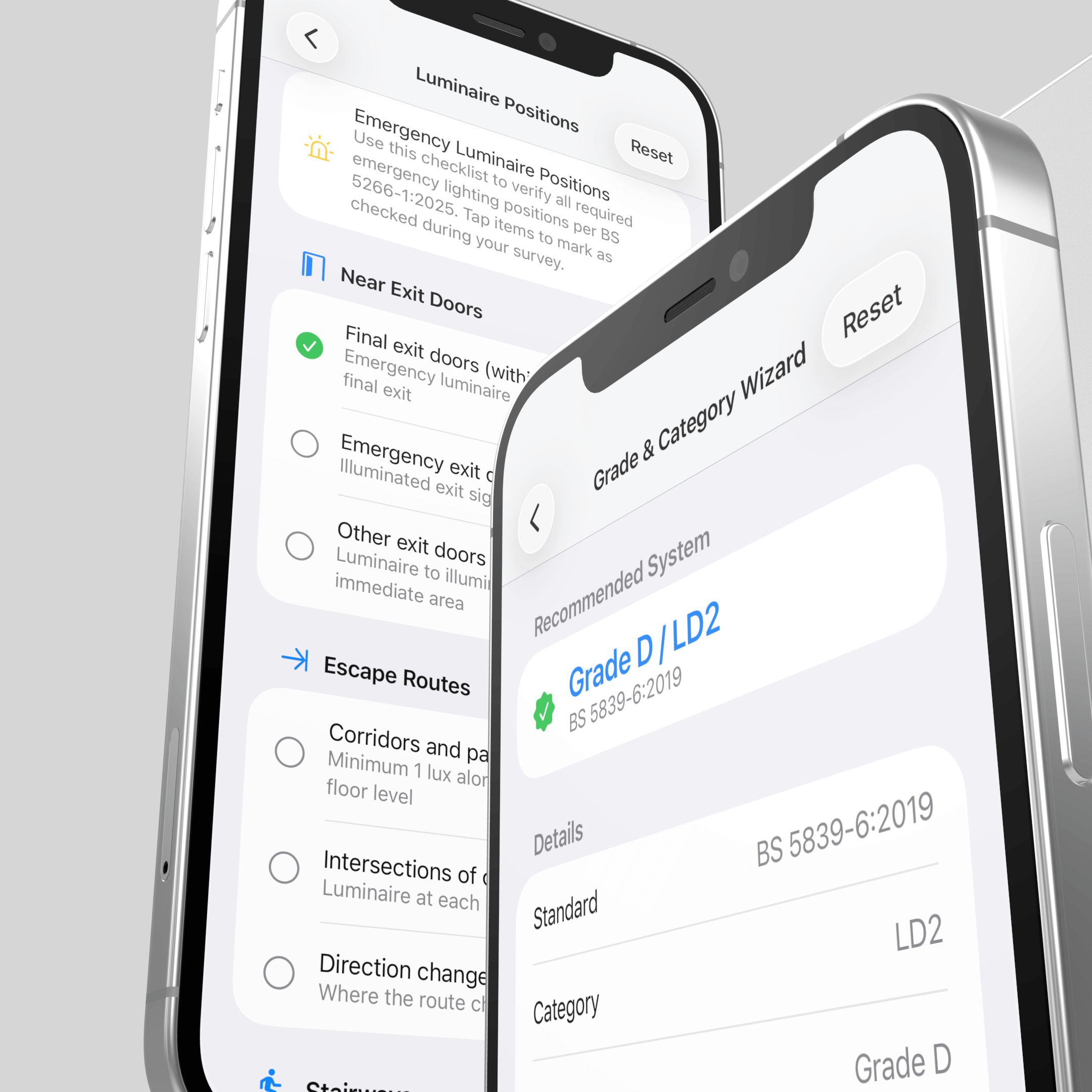
We’re excited to announce the release of Fire Safety Tools in iCertifi Fire Edition — a suite of professional utilities designed to help UK fire alarm engineers and electricians work more efficiently on-site.
Whether you’re specifying a new fire detection system, investigating false alarm issues, or surveying emergency lighting positions, these tools put essential BS 5839 and BS 5266 guidance right in your pocket.
Why We Built These Tools
As fire safety professionals, you already know that getting the specification right matters. A fire alarm system that’s under-specified puts lives at risk. One that’s over-specified costs your client money and can lead to increased false alarms.
The same applies to emergency lighting certificates and surveys — miss a required luminaire position and the installation fails to comply with BS 5266-1.
Industry Insight: We spoke to engineers who told us they were still carrying paper copies of standards, scrolling through PDFs on-site, or simply relying on memory. That’s not ideal when you’re working under time pressure or dealing with complex multi-occupancy buildings.
So we built these tools directly into iCertifi Fire Edition, available from the options menu while you’re working on any certificate.
Tool 1: BS 5839 Grade & Category Wizard
The Problem
Specifying fire alarm systems requires you to determine two critical elements:
- Category — defines the extent of detection coverage (M, L1-L5, P1-P2)
- Grade — defines the type of equipment and system configuration (A-F for non-domestic, LD1-LD3 for domestic)
The rules differ between BS 5839-1:2017+A2:2023 (non-domestic buildings) and BS 5839-6:2019+A1:2020 (domestic dwellings). Getting this wrong can mean non-compliance, failed inspections, or inadequate protection.
The Solution
Our Grade & Category Wizard walks you through the specification process step-by-step:
Step 1: Select building type — Is it a domestic dwelling or commercial/industrial premises?
Step 2: Choose property type — House, flat, HMO, sheltered housing, office, factory, warehouse, etc.
Step 3: Define protection objectives — Life safety, property protection, or both?
Step 4: Get your result — The wizard recommends the appropriate category and grade based on current standards.
The wizard covers all standard categories:
- Category M — Manual call points only, no automatic detection
- Category L5 — Localised detection for specific life safety risks
- Category L4 — Detection in escape routes only
- Category L3 — Detection in escape routes plus rooms opening onto them
- Category L2 — Detection in specified areas beyond L3
- Category L1 — Comprehensive detection throughout the building
- Category P2 — Property protection in defined areas
- Category P1 — Comprehensive property protection
For domestic properties, you’ll get the correct grade recommendation:
- Grade LD1 — Full detection with mains-powered, interlinked detectors
- Grade LD2 — Detection in circulation spaces, kitchens, and high-risk rooms
- Grade LD3 — Detection in circulation spaces only (minimum for rentals)
Benefit: No more flipping through Annex A of BS 5839-6 or trying to remember Table 4 of BS 5839-1. Get instant, accurate recommendations on-site.
Tool 2: False Alarm Rate Analyser
The Problem
False alarms waste fire service resources, cause disruption, and can lead to alarm fatigue where occupants ignore or delay responding to activations. In commercial premises, repeated false alarms may result in the fire service implementing Unwanted Fire Signal policies.
But how do you know if a system’s false alarm rate is actually problematic? Without a benchmark, it’s difficult to assess whether the number of false alarms is normal for a system of that size or whether investigation is needed.
The Solution
Our False Alarm Analyser calculates the false alarm rate per 100 detectors per year — the industry-standard metric referenced in BS 5839-1:2017+A2:2023.
Simply enter:
- Total number of automatic detectors in the system
- Number of false alarms over a 12-month period
The tool calculates the rate and provides a clear assessment:
Less than 1 per 100 detectors/year: Excellent — System performing well
1 to 2 per 100 detectors/year: Acceptable — Within normal limits
2 to 5 per 100 detectors/year: Poor — Investigation recommended
5 or more per 100 detectors/year: Unacceptable — Urgent action required
Benefit: Objective data to discuss with building managers and justify recommendations for system improvements, detector upgrades, or operational changes.
Tool 3: Emergency Lighting Position Checklist
The Problem
BS 5266-1:2025 and BS EN 1838:2024 specify where emergency luminaires must be installed. The list is extensive, and it’s easy to miss a required position during a site survey — especially in complex buildings with multiple floors, stairways, and fire safety equipment locations.
The Solution
Our Emergency Lighting Position Checklist provides a comprehensive, tappable list of all required luminaire positions. Use it during your survey to systematically check each location:
Escape Routes & Circulation
- At each exit door
- Near stairs (each flight receives direct light)
- At every change of direction
- At corridor intersections
- At every change of floor level
- Outside each final exit
Fire Safety Equipment
- At fire alarm call points
- Near fire-fighting equipment
- At fire safety signage
High-Risk & Specialist Areas
- Lift cars (3-hour duration for trapped persons)
- Moving stairways and walkways
- Toilet facilities exceeding 8m²
- Motor generator rooms
- Control rooms and plant rooms
- Covered car parks
- Changing rooms and locker areas
Signage Requirements
- Supplementary escape route signs
- Mounting height 2.0m to 2.5m above floor level
The checklist also reminds you of key technical requirements:
- Illuminance: Minimum 1 lux on escape route centre line
- Uniformity: Maximum 40:1 ratio (max to min illuminance)
- Response time: 50% output within 5 seconds, 100% within 60 seconds
- Duration: Minimum 3 hours for most applications
Benefit: Tap each item to mark it as checked during your survey. Never miss a required position again.
How to Access Fire Safety Tools
The tools are available to all iCertifi Fire Edition subscribers. To access them:
Step 1: Select Tools from the home page
Step 4: Choose the tool you need
Works Offline: The tools work completely offline — no internet connection required on-site.
Standards Referenced
All tools are built to current British Standards including the latest amendments:
- BS 5839-1:2017+A2:2023 — Fire detection and fire alarm systems for buildings. Code of practice for design, installation, commissioning and maintenance of systems in non-domestic premises
- BS 5839-6:2019+A1:2020 — Fire detection and fire alarm systems for buildings. Code of practice for the design, installation, commissioning and maintenance of fire detection and fire alarm systems in domestic premises
- BS 5266-1:2025 — Emergency lighting. Code of practice for the emergency lighting of premises
- BS EN 1838:2024 — Lighting applications. Emergency lighting
Download iCertifi Fire Edition
Ready to try the new Fire Safety Tools?
These tools are included with your subscription at no extra cost — along with all eight fire safety certificate types, PDF generation, digital signatures, and iCloud sync.


Questions or Feedback?
We’re always looking to improve iCertifi based on your feedback. If you have suggestions for additional tools or features, get in touch at support@icertifi.co.uk or leave a review on the App Store.
Tags: BS 5839, BS 5266, Fire Alarm, Emergency Lighting, False Alarms, Fire Safety Tools, App Update, Fire Safety Standards, BS 5839-1, BS 5839-6, Fire Detection Systems, Fire Alarm Engineers