BS 5839 fire alarm and BS 5266 emergency lighting
Fire Alarm & Emergency Lighting Certificate App
Complete fire safety certificates on site, straight from your iPhone, iPad or Android phone. Built for UK fire alarm engineers who need professional, standards-compliant documentation without the paperwork.


BS 5839-1 certificates for non-domestic systems
Design, commissioning and installation, acceptance, modification and the periodic inspection and servicing report, with every device tested listed on the PDF.
- BS 5839-1Fire Alarm Inspection Report
- BS 5839-1Fire Detection Design, Commissioning & Installation
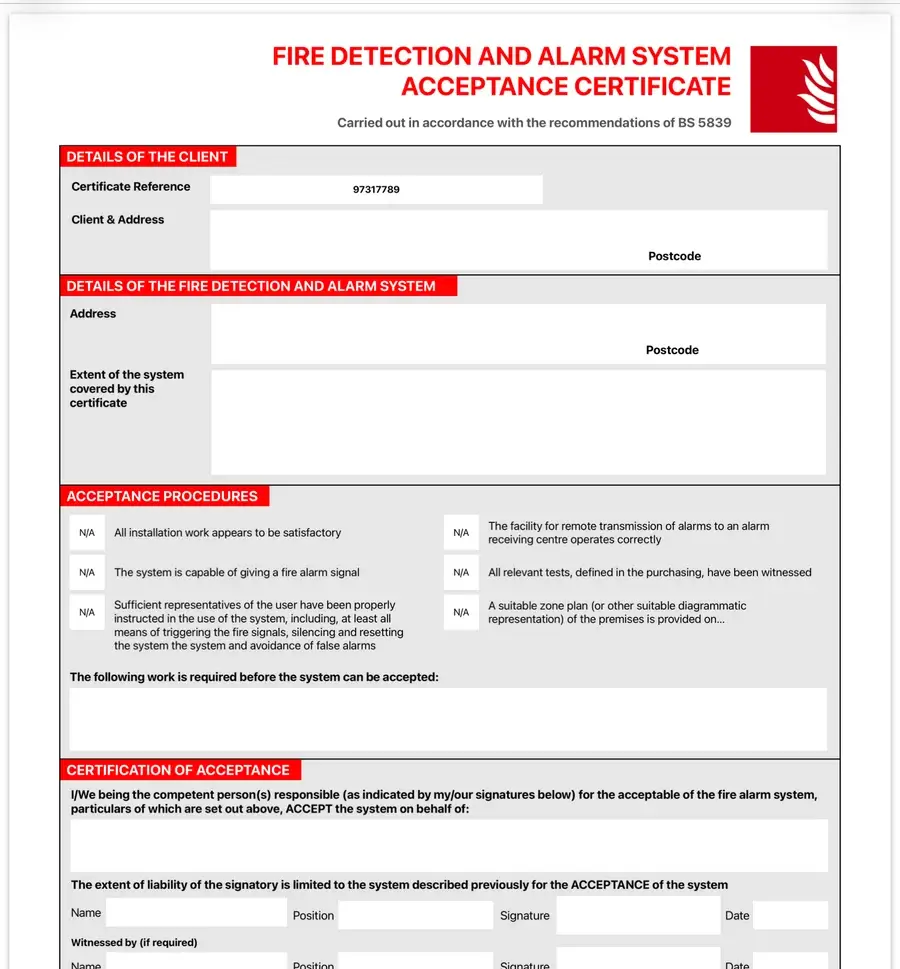
- BS 5839-1Fire Alarm Acceptance Certificate
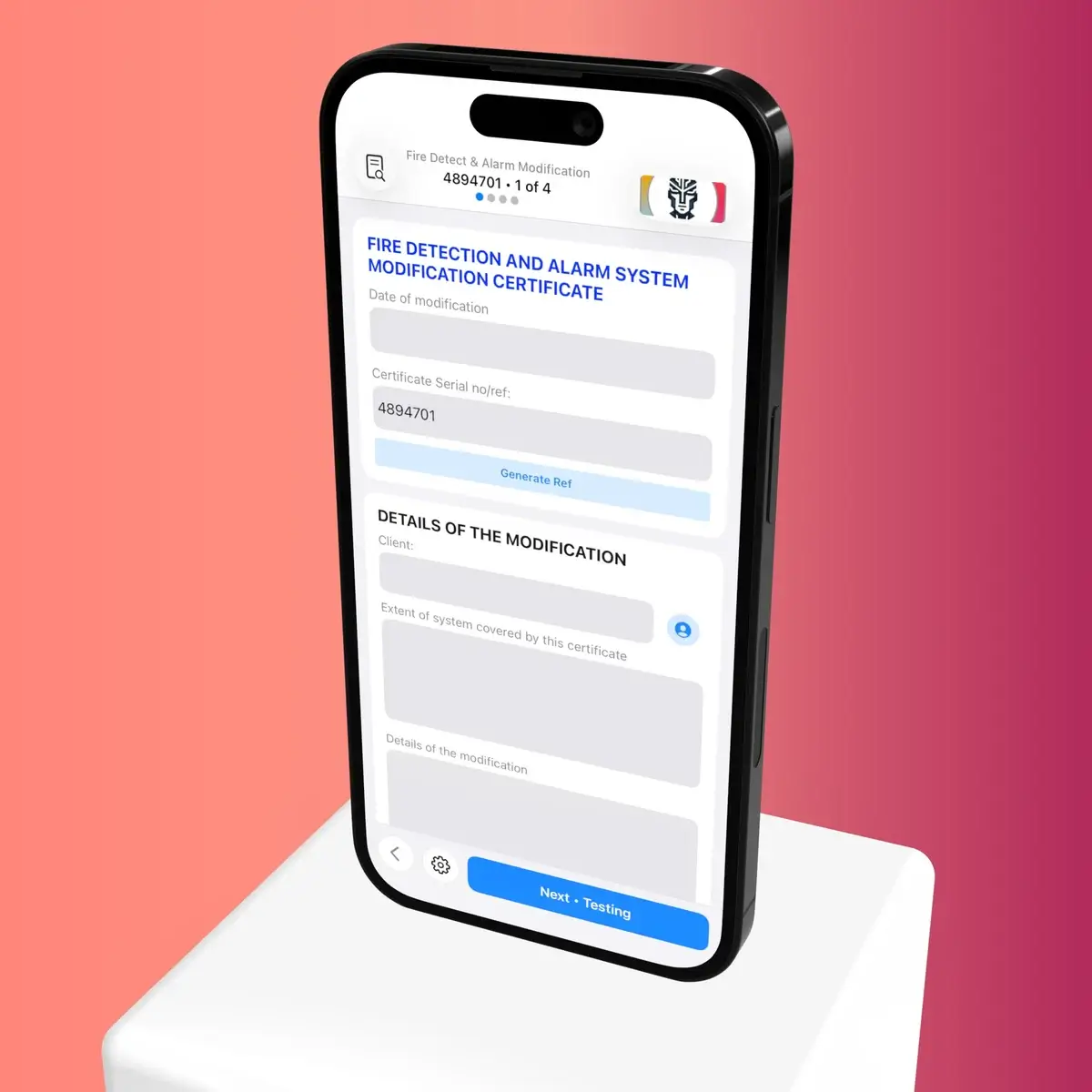
- BS 5839-1Fire Detection & Alarm Modification
BS 5839-6 certificates for homes and HMOs
The domestic fire detection and alarm service report and the smoke and heat alarm certificate, with the Grade and Category Wizard writing the classification in for you.
- BS 5839-6Domestic Fire Detection & Alarm Service Report
- BS 5839-6Smoke & Heat Alarm Certificate
BS 5266-1:2025 emergency lighting certificates
Both emergency lighting certificates are written to BS 5266-1:2025. Fill them in as you walk the building, sign on screen and email the PDF before you leave. The monthly and full duration tests are recorded against every light.
- BS 5266-1Emergency Lighting Completion Certificate
- BS 5266-1Emergency Lighting Periodic Inspection and Testing Certificate (PIR)
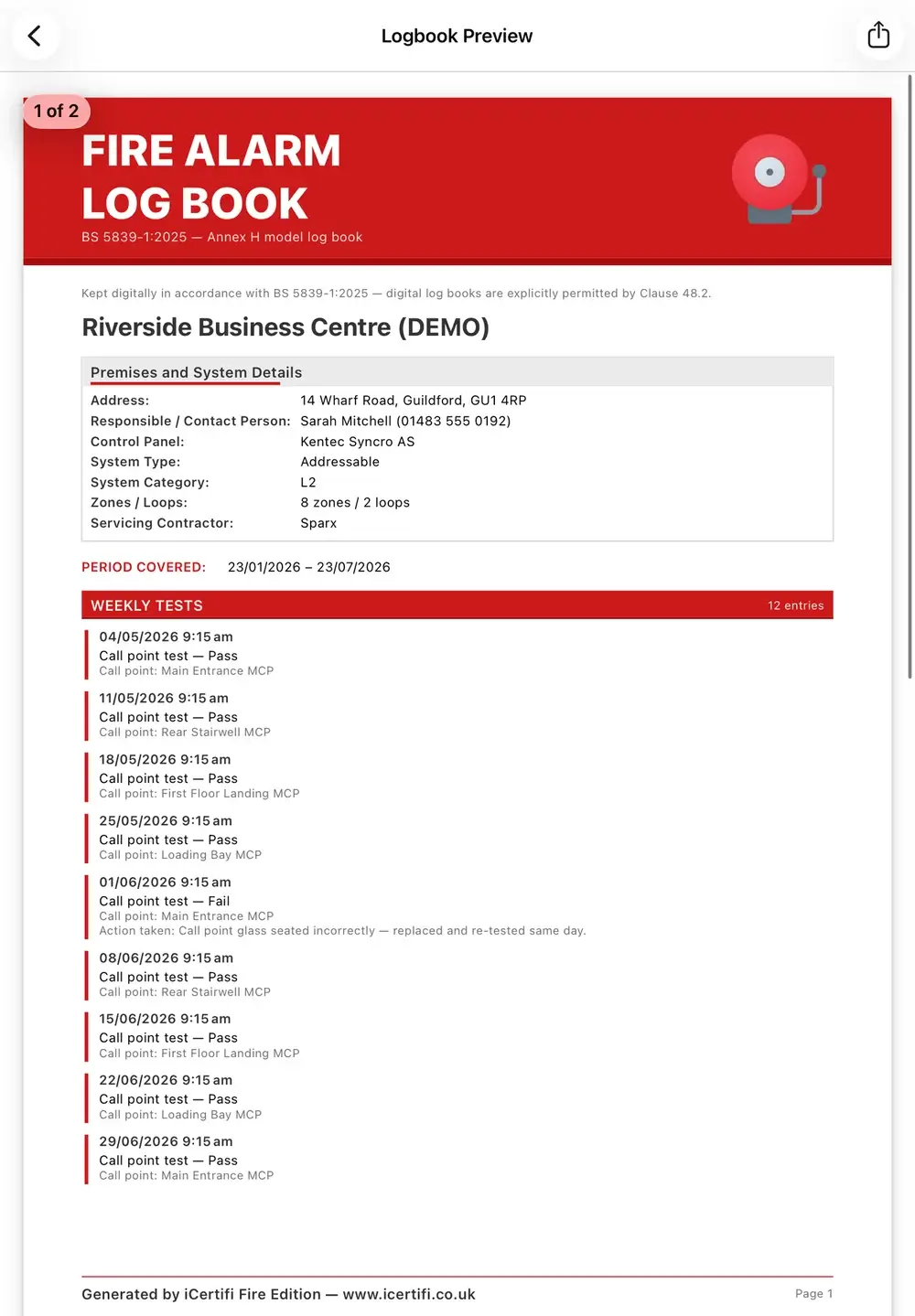
A BS 5839-1 Annex H fire alarm log book for each building
One log book per building. Weekly tests, faults, false alarms, service visits and battery changes - all timestamped, all exportable on the BS 5839-1:2025 Annex H model log book.
- BS 5839-1 Annex HFire Alarm Log Book
8 fire safety certificates. All major British Standards. Complete them on site, send them before you leave.
Devices tested
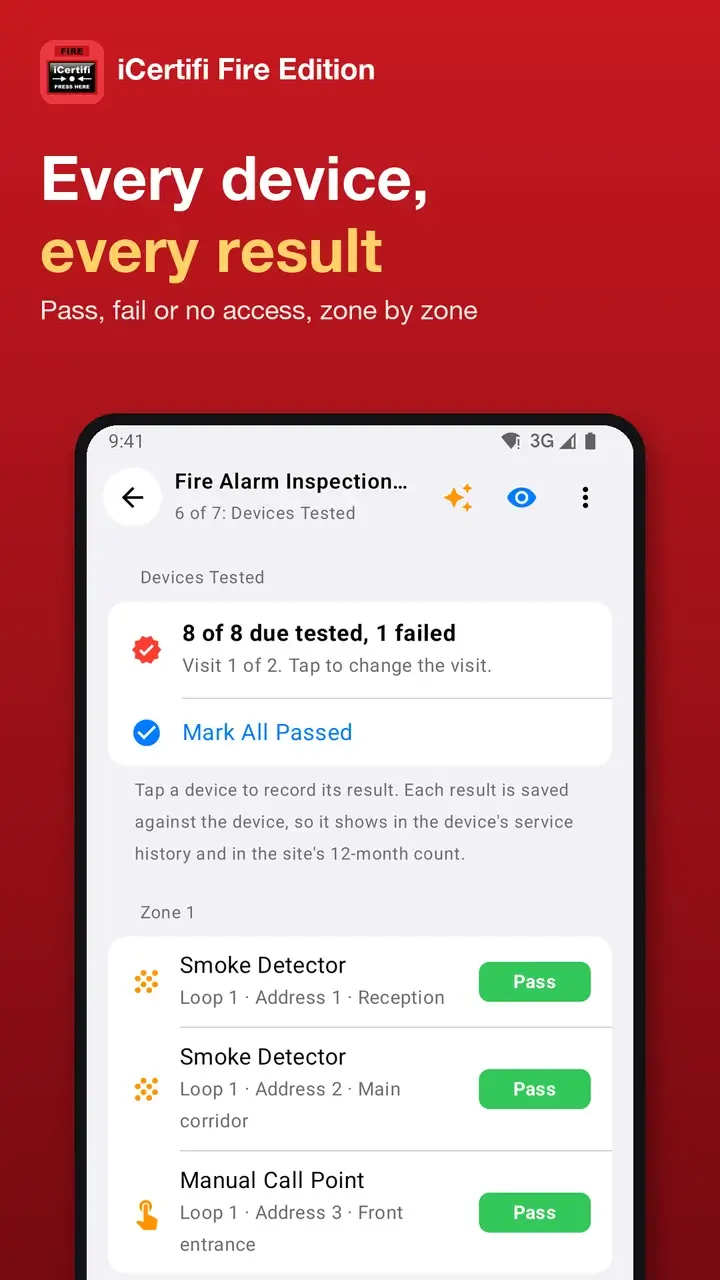
A fire alarm test certificate with every device on it: pass or fail
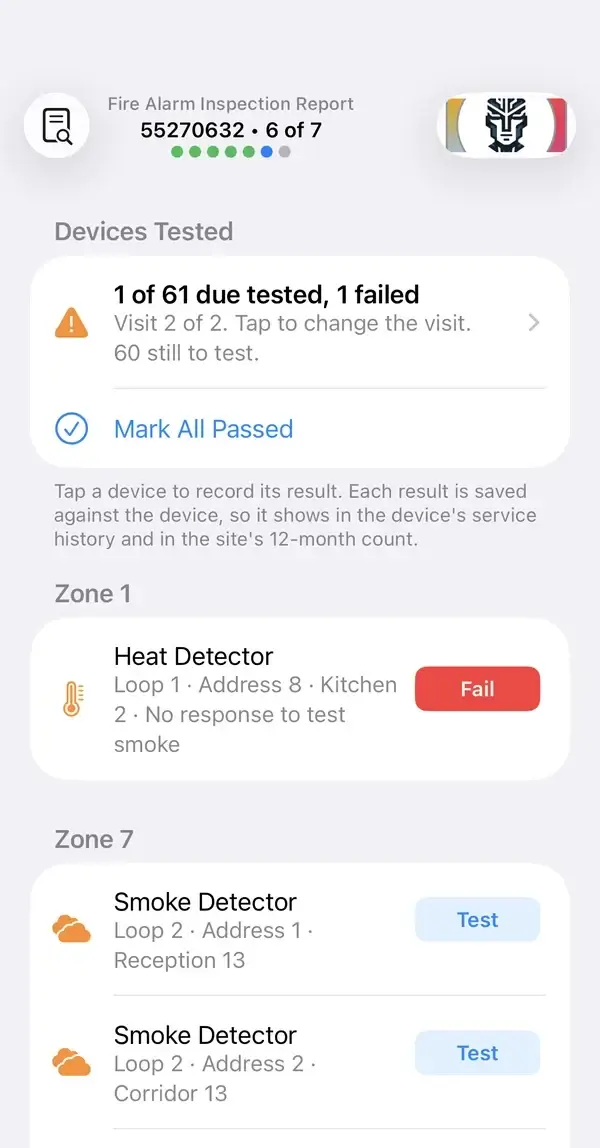
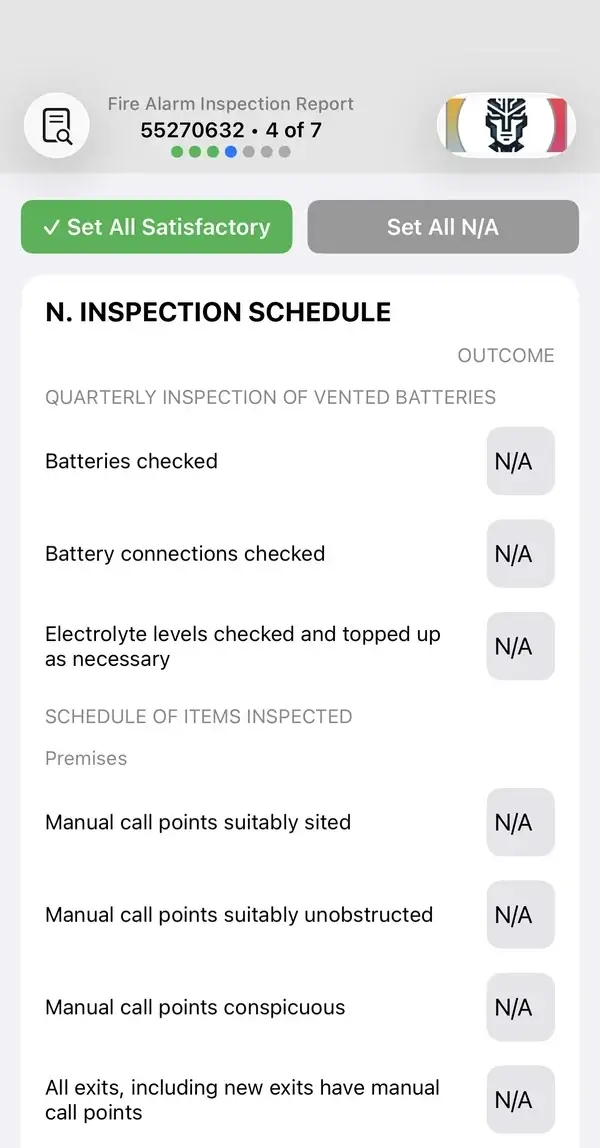
Link a Fire Alarm Inspection Report to a site and the app lists the devices due this visit. Record a result against each one and the list prints with the certificate.
- Pass, Fail or Not accessible against each device, or tap Mark All Passed and change the exceptions.
- Device rotation. Devices are split across 2 or 4 visits a year, so every device is tested over the year.
- A failed device becomes an observation on the report automatically, and stays on the site's Open Defects list until you mark it put right.
- The PDF lists the devices tested, with the site total tested in the last 12 months.
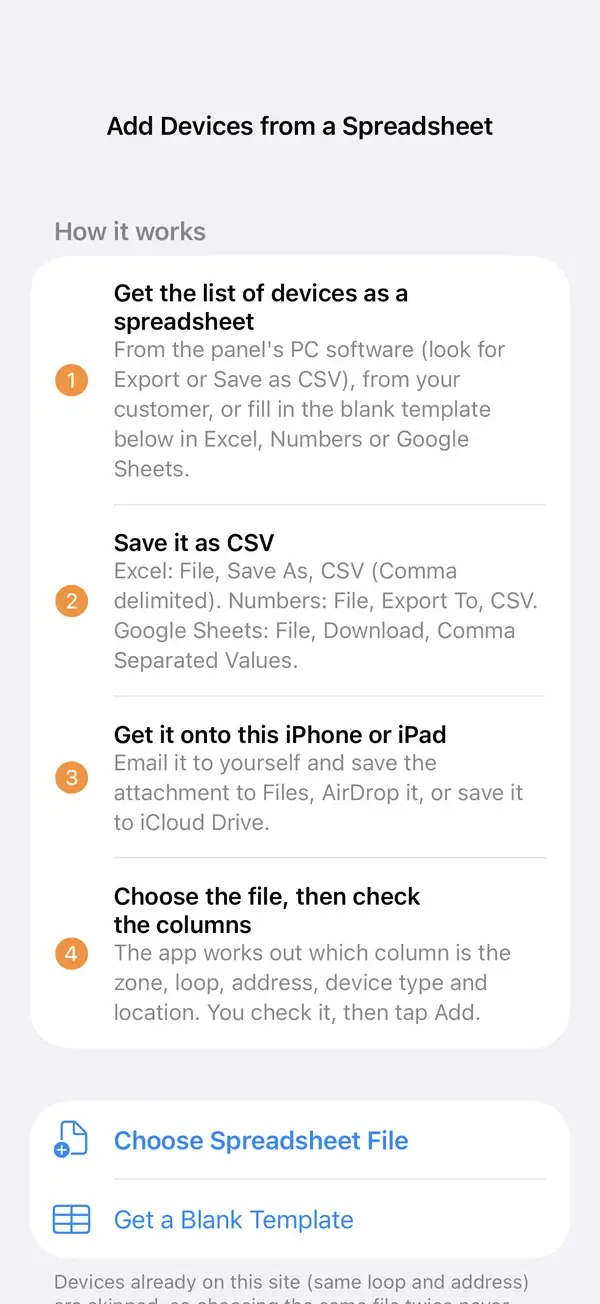
- Add a whole site from a spreadsheet. Import the device list from a CSV file saved from Excel, Numbers or Google Sheets. A blank template is included.
- Photos on any device and any observation, and scanning a device's NFC tag opens that device straight away.
More of the app, scroll sideways
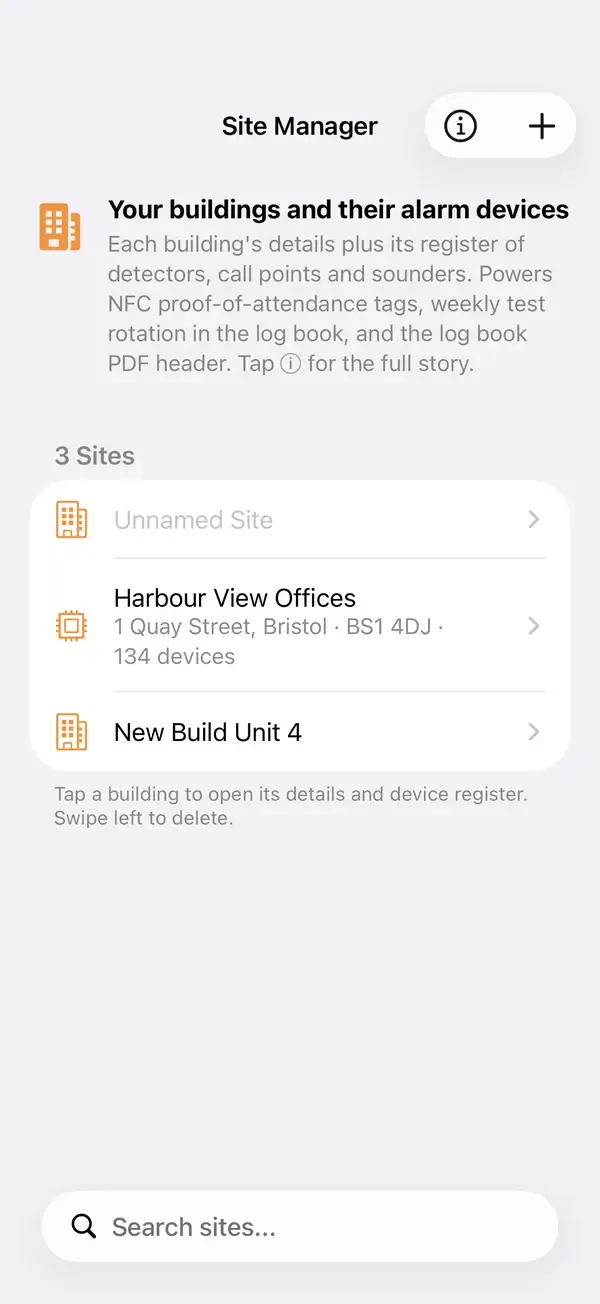
Site Manager
Each building, its panel details and its register of alarm devices and emergency lights.
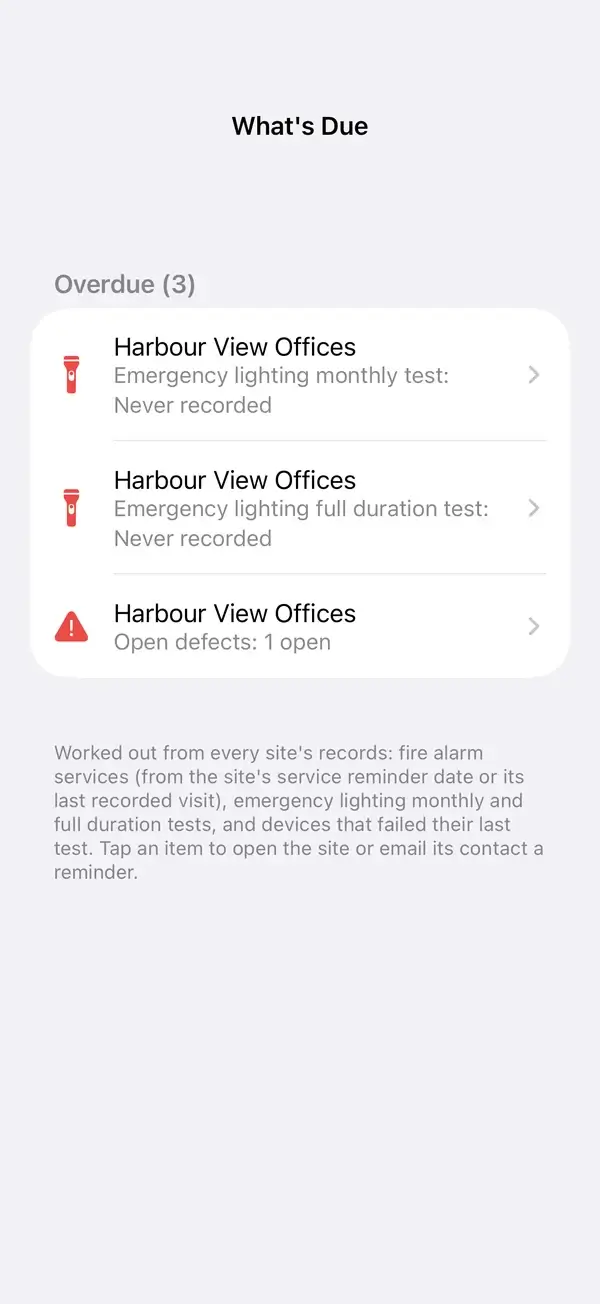
What's Due
Every site with a service, emergency lighting test or defect that is due or overdue.
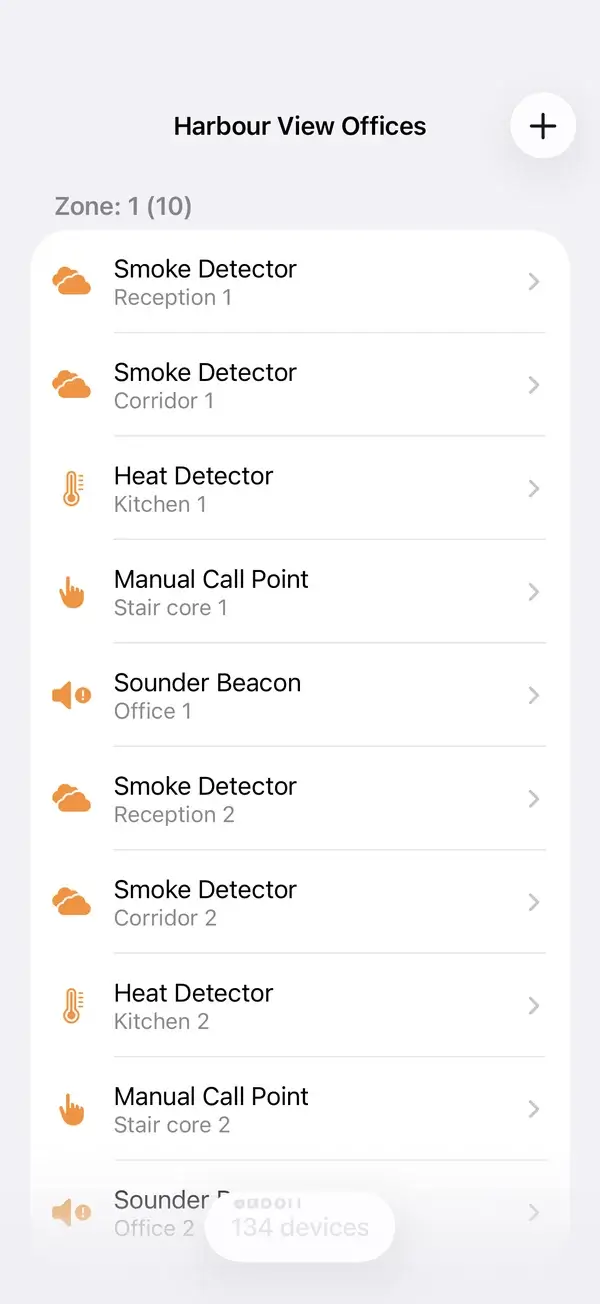
Device register
40+ device types per BS 5839-1:2025, grouped by zone, with service history.
Emergency light register
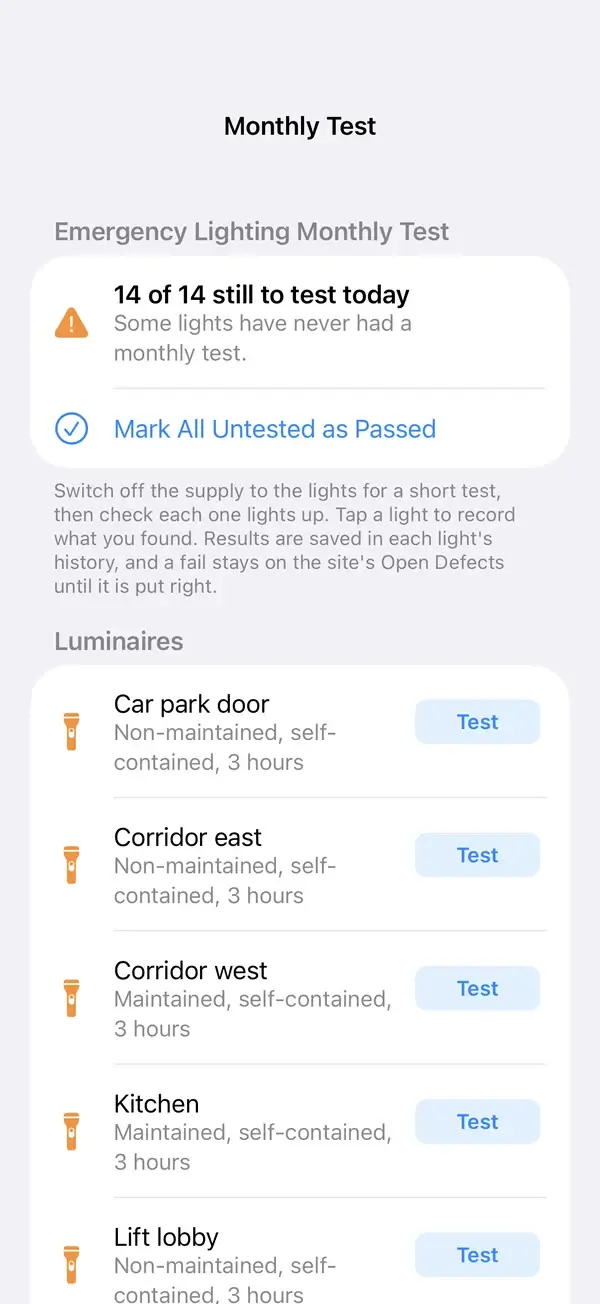
Monthly and full duration tests against every light.
Import from a spreadsheet
Add a whole site from a CSV saved from Excel, Numbers or Google Sheets.
Inspection schedule
Set All Satisfactory, then change the exceptions.
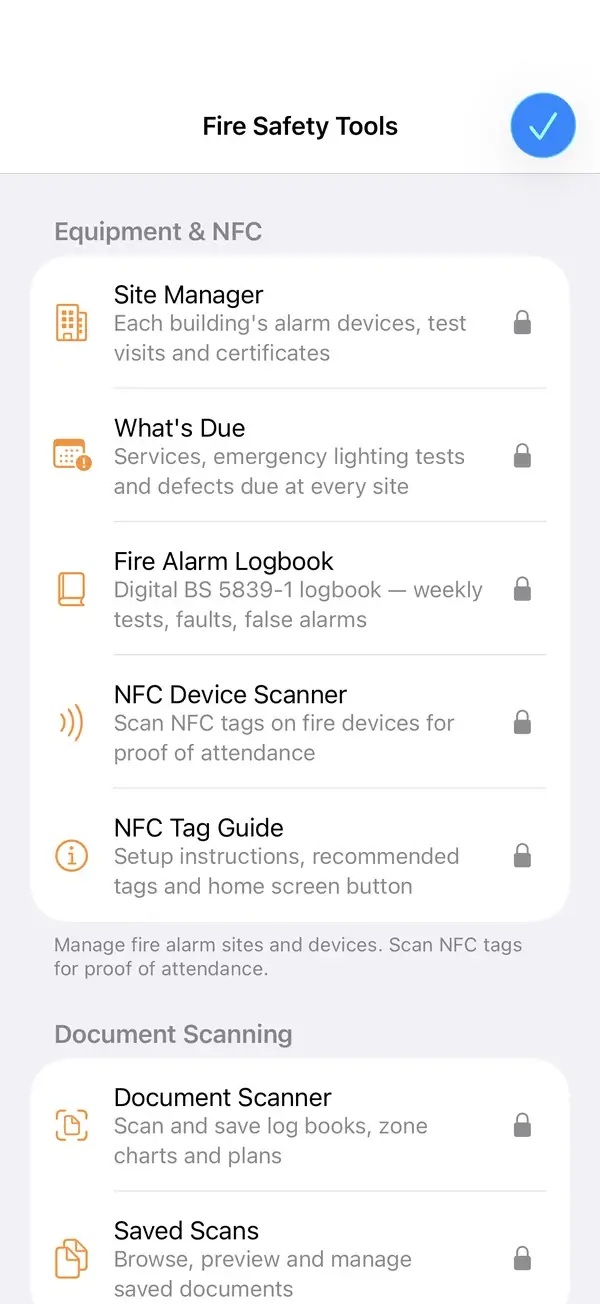
Fire Safety Tools
One menu for every tool. Open one from a certificate and the result goes on it.
Emergency lighting
Emergency lighting test certificates to BS 5266-1, completed and signed on site
Both emergency lighting certificates are written to BS 5266-1:2025. Fill them in as you walk the building, sign on screen and email the PDF before you leave.
BS 5266-1:2025
Emergency Lighting Completion Certificate
For a new installation, or the verification of an existing one. The design, construction and verification declarations are each signed by the person responsible, on the one certificate.
- Design declarationSigned
- Construction declarationSigned
- Verification declarationSigned
Includes the design, construction and verification conformity checklists, deviations from the standard, the organisations responsible (filled in from your contractor details), light meter and test instrument details, and the recommended interval to the next inspection.
BS 5266-1:2025
Emergency Lighting Periodic Inspection and Testing Certificate
The emergency lighting test certificate for an existing installation. Work down the inspection schedule, each item shown with its BS 5266-1 clause, and record the outcome.
- Luminaires operate for their full rated duration✓
- Charging indicators operate after test✓
- Log book test records complete✓
Records the purpose of the system (escape route, open area, standby and high risk task area lighting), the arrangement of the installation (self-contained or central supply, maintained or non-maintained, duration), the light meter used, deviations and the next inspection interval.
Emergency light register
Each emergency light on the site, with its type, supply and duration. Record the monthly test and the full duration test against every light, and the Luminaires Tested page prints each light with its result on both certificates.
Luminaire Position Checklist
Walk the building against the positions BS 5266-1 expects: exits, stairs, changes of direction, call points and more.
SparkAI
Ask about BS 5266, illuminance levels and test durations while you are on site.
Document Scanner
Scan the log book, drawings and photometric data into the certificate.
NFC equipment tagging
Scan. Tag. Prove you were there.
NFC Equipment Tagging for Fire Alarm Engineers
Stick an NFC tag on any fire alarm device - detector, call point, sounder, panel - and scan it on every visit. Hardware-locked UIDs, unclonable, meeting BAFE SP203 and FIA verification requirements.
- 01
Step 1 - Set up
Site Manager
Organise your sites with system type, panel details, and contact information. Every device you tag links back here.
- 02
Step 2 - Register
Device Register
Track 40+ device types per BS 5839-1:2025 with zone grouping, service history, and replacement date tracking.
- 03
Step 3 - Program
Write Tags
Write device identity to any NTAG215 tag directly from the device detail screen. One tag per device, permanently linked.
- 04
Step 4 - Scan on site
NFC Proof of Attendance
Scan tags to automatically log timestamped service records with GPS-grade hardware verification. Instant proof you were there.
- 05
Step 5 - Review
Service History & Search
Full audit trail of every scan, every visit, timestamped and linked to each device. Search by location, zone, manufacturer, or model across all sites.
Access from the Tools menu. Enable the home screen NFC scan button in Settings > NFC Equipment Tags.
Fire alarm log book app
The weekly test that logs itself
Digital log books are explicitly permitted
The 2025 revision of BS 5839-1 caught up with how people actually work. Clause 48.2 recognises a digital log book as an acceptable record - provided it is complete, secure and readily available for inspection. iCertifi Fire Edition is built to be all three.
One log book per building. Weekly tests, faults, false alarms, service visits and battery changes - all timestamped, all exportable on the BS 5839-1:2025 Annex H model log book. More about the fire alarm log book app ›
Fire Alarm Log Book Weekly testing of fire alarm system
| Date | Point | Result | Signed |
|---|---|---|---|
| 4/7 | MCP-05 | OK | J.A. |
| 11/7 | ? | OK | — |
| 18/7 | MCP-06 | OK | J.A. |
Week of 11 July: no point recorded, no signature. On an inspection, that is the week that gets asked about.
Fire Alarm Log Book Unit 4, Kingsway
| Date | Point | Result | Logged by |
|---|---|---|---|
| 04 Jul 09:12 | MCP-05 | Pass | T. Hughes |
| 11 Jul 08:55 | MCP-06 | Pass | S. Patel |
| 18 Jul 09:03 | MCP-06 | Pass | T. Hughes |
| 25 Jul 09:41 | MCP-07 | Pass | T. Hughes |
No week without a record. Every row timestamped as it happens, with the rotation tracked for you - MCP-07 was next, so MCP-07 is what the app offered. Export Annex H.
Compliance tools
Battery standby calculator, false alarm analyser, luminaire checklist and sound level meter
The sums and checks BS 5839 and BS 5266 ask for, worked out on site and kept with the job.
BS 5839-1:2025 Annex E
Battery Standby Calculator
Enter the standby and alarm currents and the battery fitted. The app works out the minimum capacity and tells you whether the battery passes. Choose the system category and the standby period is set for you.
Cmin = 1.25 (T1 × I1 + D × I2 × T2)
Example: 24 hours standby at 120 mA, 30 minutes alarm at 450 mA, derating 1.75. Opened from an inspection report or design certificate, the calculation prints on its own page. A battery below the minimum can be added as an observation.
BS 5839-1:2025 Annex F
False Alarm Rate Analyser
Works out the false alarm rate per 100 detectors per year and checks it against the test the standard applies to a system of that size. Tap Use Logbook Data and the detector count and false alarms come from the site's own register and log book.
Tap Apply to Certificate and the rate is written into the Fire Alarm Inspection Report. Common causes of false alarms are listed for the report.
BS 5266-1:2025
Luminaire Position Checklist
A walk-round checklist of where an emergency luminaire or exit sign is expected, so nothing is missed on a completion or periodic inspection.
Also covers exit signs, changes of direction, accessible toilets, refuges, plant and generator rooms, first aid points and high risk task areas.
BS 5839-1 sounder levels
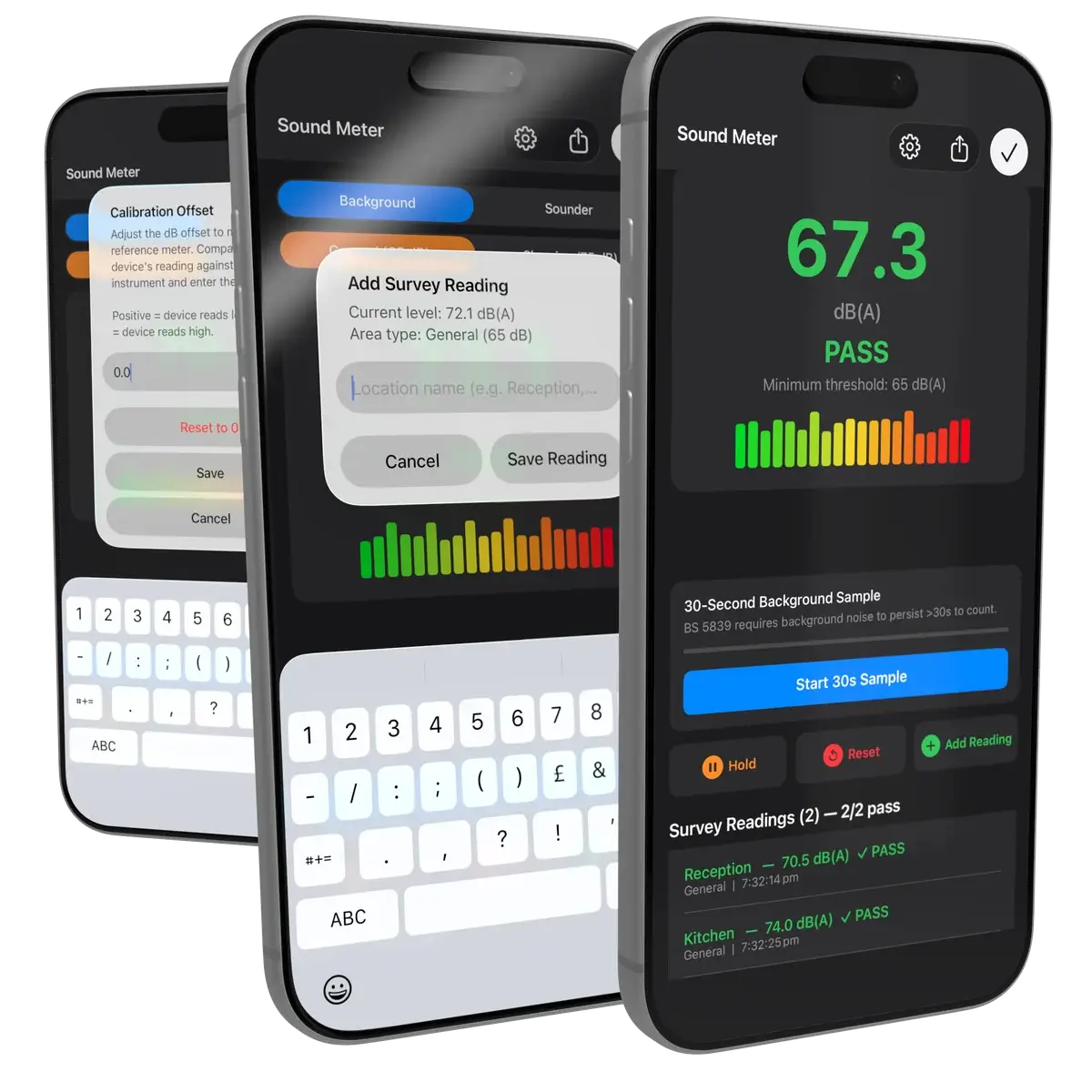
Sound Level Meter
Take a 30 second background sample, then add a reading at each point you measure. Each reading is checked against the level for that area and how far it is above background.
Share the readings as a sound level survey report. The meter is an estimate from the device microphone, with a calibration offset, and should be checked against a calibrated instrument.
Zero copy and paste
Your tools talk to your certificates
Calculate a grade, category, or false alarm rate - then tap one button. The result writes itself into the correct certificate field. No switching screens. No retyping.
Tool calculates
Grade & Category Wizard
- System Grade
- Grade A
- Category
- LD2
Certificate updated
Domestic Fire Detection
- System Grade
- Grade A ✓
- Category
- LD2 ✓
Works with Domestic Fire Detection and Smoke & Heat Alarm certificates for grade and category, and Fire Alarm Inspection certificates for false alarm rate.
Inspection interval calculator
Every BS 5839 date. Calculated in seconds.
Enter your last inspection date, choose domestic or non-domestic, tap Calculate. Every key date, colour-coded and instant.
Last inspection 21 Mar 2025
- Weekly MCP test28 Mar 2025Overdue
- Monthly visual check21 Apr 2025Due soon
- 6-monthly service21 Sep 2025OK
- Annual inspection21 Mar 2026OK
- Battery replacement21 Mar 2028OK
- Detector replacement21 Mar 2035OK
Supports BS 5839-1 (non-domestic) and BS 5839-6 (domestic) intervals. Example dates.
Fire safety tools
Every fire alarm and emergency lighting tool, built in
One Tools menu for the jobs you would otherwise do on paper, in a spreadsheet or with another app. Open a tool from a certificate and the result goes onto that certificate.
Every tool, in three groups, listed below.
Equipment and NFC
Site Manager
Each building, its panel details and its register of alarm devices and emergency lights.
What's Due
Every site with a service, emergency lighting test or defect that is due or overdue.
Fire Alarm Log Book
Digital BS 5839-1 log book: weekly tests, faults, false alarms and service visits.
NFC Device Scanner
Scan the tag on a device as proof of attendance.
NFC Tag Guide
Which tags to buy and how to set them up.
Document scanning
Document Scanner
Scan log books, zone charts and floor plans into the certificate.
Saved Scans
Browse, preview and manage the documents you have scanned.
Compliance tools
Grade and Category Wizard
BS 5839-1 and BS 5839-6 system classification in three steps.
Battery Standby Calculator
BS 5839-1 Annex E: minimum battery size, pass or fail.
False Alarm Rate Analyser
False alarms per 100 detectors per year, from the log book.
Luminaire Position Checklist
Where BS 5266-1 expects an emergency luminaire.
Inspection Intervals
Next service, inspection and test dates from the last visit.
Sound Level Meter
Ambient and sounder dB(A) levels, with a survey report.
How the fire safety tools work › · Servicing extinguishers as well? Fire Safe, the fire extinguisher servicing app ›
Invoicing without retyping
Certificate done. Invoice done.
Link iCertifi Fire Edition to Mint Books and stop typing the same job out twice. Save a certificate and Mint Books builds the draft invoice.

- No double entry
- Matched by reference number, so it never creates a duplicate
- No signal on site? It queues and sends when you are back online
- Invoices, bookkeeping and Making Tax Digital in one app
See the Mint Books integration › · How the Mint Books link works in iCertifi ›
Fire Alarm Inspection · 14 Oak Lane
SavedDraft
- Bill to
- J. Smith
- Property
- 14 Oak Lane
- Certificate
- Fire Alarm Inspection Report
- Amount
- From your Certificate Pricing
- 1
Finish the certificate
Complete your fire alarm or emergency lighting certificate as you always do.
- 2
Save it
The job details go to Mint Books automatically.
- 3
Mint Books builds the draft
Client and property arrive as a draft invoice, priced from your Certificate Pricing in Mint Books.
- 4
Check it, send it, get paid
Change the price or add a line, then send. Nothing leaves without you.
Built-in document scanner
Point. Scan. It's in your PDF.
No separate app. No photos cluttering your camera roll. Scan directly from the Tools menu and it lands straight in your certificate.
- 1
Scan
Log books, zone charts, certificates, plans
- 2
Clean up
Multi-page capture, auto-straighten, edge detection
- 3
Attach
Final PDF, attached and ready
Smart field suggestions
Your certificates learn how you work
Every field remembers your previous entries. Tap a field, tap a suggestion. The more certificates you complete, the faster you get.
Fire Alarm Inspection Report
- Acme Property Management
- Acme Motors Ltd
- 14 High Street, Manchester
- Unit 7 Riverside Business Park
- L1 addressable system, Advanced MxPro panel
- LD2 Grade D domestic system
Each field has its own memory. Client names suggest client names. Postcodes suggest postcodes. It just works.
Built for speed on site
Less typing. More installing.
Every feature is designed to cut time on site. Here's what one tap replaces.
- Typing an address manually~45 secGPS Lookup - instant
- Entering client details from scratch~60 secContacts Import - 1 tap
- Starting a repeat visit cert from blank~3 minDuplicate - 1 tap
- Copying client address to occupier fields~30 secCopy Client - 1 tap
- Working out ref numbers and dates~20 secAuto Refs - done
- Finding a WiFi signal to save your work???Offline - always works
Professional PDF output
Certificates that look like you mean business
Every certificate follows the correct format for its British Standard. Add your logo, pick your brand colours, and send.
Email, AirPrint, Dropbox, Google Drive, OneDrive, and more.
SparkAI, built-in AI assistant
Like having a fire safety expert in your pocket
Ask anything about BS 5839, BS 5266, system design, or inspection requirements. Get answers while you work, not after you leave site.
Expert guidance on BS 5839-1, BS 5839-6, BS 5266, system design, inspection requirements, and best practice. More about SparkAI ›
SparkAI Online
What grade and category do I need for a 3-storey HMO with a shared kitchen?
For a 3-storey HMO with a shared kitchen, BS 5839-6:2019 recommends a Grade D1, Category LD2 system as minimum. LD2 covers escape routes plus rooms where fire is most likely to start - the shared kitchen is the key risk room here.
Does it need a heat detector or smoke in the kitchen?
Heat detector. BS 5839-6 clause 11.2 states kitchens should have heat detection to avoid false alarms from cooking. An A1R or A2S to BS EN 54-5 grade 1 is typically specified.
Ask SparkAI anything about fire safety standards…
On Google Play
Fire alarm certificates on Android
iCertifi Fire Edition runs on Android phones and tablets, with the same eight BS 5839 and BS 5266 certificates as the iPhone and iPad app.
- The same certificates and PDFs, signed on screen and emailed from the job.
- Site register, NFC tags, the fire alarm log book and the Fire Safety Tools are all included.
- Works without a signal. Certificates are kept on your phone.
- Backup and Restore is an optional yearly add-on: back up to a file you keep, such as on Google Drive, and restore on a new phone.
- Subscriptions on Android are taken through Google Play and are separate from an App Store subscription.
Needs Android 10 or later. See iCertifi Fire Edition prices ›
BS 5839 & BS 5266 reference
Everything UK fire alarm engineers need to know
A quick reference on grades, categories and inspection intervals - built into the certificates iCertifi produces.
BS 5839-1
Commercial & non-domestic
Offices, retail, industrial, schools, hotels, HMOs over 3 storeys. Specifies system Categories M, L1-L5 and P1-P2.
BS 5839-6
Domestic dwellings
Single private dwellings and HMOs of 1-2 storeys. Specifies system Grades A, B, C, D1, D2, F1 and F2.
BS 5839-1 system categories
- MManual systems only - no automatic detection. Manual call points only.
- L1Life protection - detection in all rooms and circulation areas.
- L2Life protection - detection in escape routes, adjoining rooms and high-risk areas.
- L3Life protection - detection in escape routes and adjoining rooms.
- L4Life protection - detection in escape routes only.
- L5Life protection - bespoke risk-based system designed for a specific area.
- P1Property protection - detection throughout the building.
- P2Property protection - detection in defined areas of high risk.
BS 5839-6 domestic grades
- ABS 5839-1 commercial-style system, designed and installed to BS 5839-6.
- CMains-powered detectors with a control unit and standby supply.
- D1Mains-powered, interlinked smoke alarms with sealed tamper-proof battery backup. Most common in HMOs and rented homes.
- D2Mains-powered, interlinked smoke alarms with replaceable battery backup.
- F1Battery-only smoke alarms with sealed tamper-proof battery.
- F2Battery-only smoke alarms with replaceable battery.
Inspection & servicing intervals
Fire alarm - BS 5839-1
- WeeklyManual call point test, rotated weekly.
- MonthlyVisual inspection and standby power check.
- 6-monthlyService inspection by a competent person.
- AnnualFull system test and certification.
Emergency lighting - BS 5266-1
- MonthlyBrief function test of all luminaires.
- AnnualFull-rated duration test (1 or 3 hours), certificate issued.
- After installCommissioning certificate and design declaration.
Who needs these certificates
- Landlords & HMOs - fire detection certification is a legal requirement for licensed HMOs and is required for most landlord insurance policies.
- Workplaces - under the Regulatory Reform (Fire Safety) Order 2005, the responsible person must ensure the fire alarm and emergency lighting are tested and certified.
- Care homes & CQC-regulated premises - service certificates form part of the CQC inspection record.
- Schools & public buildings - annual servicing and 3-hour emergency lighting tests are required and routinely audited.
- Commercial premises - insurance policies typically mandate annual fire alarm certification by a competent engineer.
FAQ
Fire alarm & emergency lighting questions, answered.
Can I produce an emergency lighting test certificate in the app?
Yes. iCertifi Fire Edition includes the Emergency Lighting Periodic Inspection and Testing Certificate and the Emergency Lighting Completion Certificate, both written to BS 5266-1:2025. Both are completed on site, signed on screen and emailed as a PDF.
Is iCertifi Fire Edition available on Android?
Yes. iCertifi Fire Edition is on Google Play for Android phones and tablets running Android 10 or later, as well as on the App Store for iPhone and iPad. The Android app has the same eight BS 5839 and BS 5266 certificates, the site register, NFC tags, the fire alarm log book and the Fire Safety Tools. On Android your certificates are kept on the phone, with an optional Backup and Restore add-on, and the subscription is taken through Google Play.
What tools are included in iCertifi Fire Edition?
Twelve. Site Manager, Fire Alarm Log Book, NFC Device Scanner, NFC Tag Guide, Document Scanner, Saved Scans, Grade and Category Wizard, Battery Standby Calculator, False Alarm Rate Analyser, Luminaire Position Checklist, Inspection Intervals and Sound Level Meter. They are all in the Tools menu and need a subscription.
Can the app calculate fire alarm battery standby capacity?
Yes. The Battery Standby Calculator follows BS 5839-1:2025 Annex E. Enter the standby current, the alarm current and the battery fitted, and it works out the minimum capacity and whether the battery passes. Opened from an inspection report or a design certificate, the calculation prints on its own page of the certificate.
Does iCertifi Fire Edition have a sound level meter for fire alarm sounders?
Yes. The Sound Level Meter measures background noise and sounder levels in dB(A) and checks each reading against 65 dB(A) for general areas, 75 dB(A) at the bedhead in sleeping areas and 5 dB(A) above background. Readings can be shared as a survey report. It is an estimate from the device microphone and should be checked against a calibrated instrument.
Do I legally need a fire alarm certificate in the UK?
Yes, in most cases. Under the Regulatory Reform (Fire Safety) Order 2005 the responsible person for a non-domestic premises must ensure the fire detection system is tested and maintained, and a written record kept. Licensed HMOs, care homes, schools and most commercial buildings have explicit certification requirements. Insurance policies typically demand current annual certification.
What is BS 5839?
BS 5839 is the British Standard covering the design, installation, commissioning and maintenance of fire detection and fire alarm systems. It is split into BS 5839-1 (commercial and non-domestic premises) and BS 5839-6 (domestic dwellings, including HMOs of 1–2 storeys). Compliance with BS 5839 is the benchmark required by insurers, regulators and most enforcing authorities.
What is the difference between BS 5839-1 and BS 5839-6?
BS 5839-1 covers commercial and non-domestic premises and uses Categories (M, L1–L5, P1–P2) to define system scope. BS 5839-6 covers domestic dwellings — single homes and HMOs of 1–2 storeys — and uses Grades (A, C, D1, D2, F1, F2) to define the type of detector and power source. Grade D1 interlinked mains alarms with battery backup are the most common HMO and rental dwelling specification.
How often must a fire alarm system be tested?
Under BS 5839-1, a manual call point should be tested weekly (rotated through the building so every MCP is tested at least every 12 months), a visual check completed monthly, a service inspection every 6 months by a competent engineer, and a full system test annually with a certificate issued. iCertifi’s Inspection Interval Calculator works out every key date from the last inspection in seconds.
What is an emergency lighting certificate?
An emergency lighting certificate is the written record that an emergency lighting system has been designed, installed, commissioned, tested or serviced in accordance with BS 5266-1. The standard recognises four certificates: design, installation, commissioning, and periodic inspection & testing. iCertifi includes the Emergency Lighting Completion Certificate, which carries the design, construction and verification declarations, and the Periodic Inspection and Testing Certificate, both written to BS 5266-1 and ready to email as a PDF on site.
How often must emergency lighting be tested?
BS 5266-1 requires a brief monthly function test of every luminaire and exit sign, and an annual full-rated-duration discharge test (1 hour or 3 hours, depending on the luminaire rating), with the system fully recharging afterwards. The annual test must be certified and the result recorded in the system log book.
Do landlords need a fire alarm certificate?
Licensed HMOs require current fire detection certification as a condition of licence. For single-let private rentals, English law requires a working smoke alarm on every storey and a carbon monoxide alarm in every room with a fixed combustion appliance — a written test certificate at the start of each tenancy is best practice and is requested by most letting agents and insurers. Scotland and Wales have their own equivalent and stricter rules.
What is a Grade D fire alarm system?
Grade D under BS 5839-6 is a system of mains-powered, interlinked smoke alarms with battery backup. Grade D1 uses sealed tamper-proof batteries (10-year life), Grade D2 uses replaceable batteries. Grade D1 LD2 is the typical specification for licensed HMOs in England and Wales.
What is the current BS 5266-1 standard?
BS 5266-1:2016 was the long-running edition; an updated BS 5266-1:2025 was published bringing alignment with BS EN 1838 illuminance levels and new guidance on adaptive emergency lighting. iCertifi’s emergency lighting certificates are kept current with the latest edition.
What is the difference between a fire alarm service certificate and a fire alarm test certificate?
A service certificate records the routine 6-monthly or annual maintenance visit by a competent engineer — a function and integrity check of every device. A test certificate is issued after the annual full system test, with every detector, call point, sounder and zone individually tested and the result recorded. Both are part of the BS 5839-1 maintenance regime.
Ready to go paperless?
iCertifi Fire Edition. Built for UK fire alarm engineers.