On Thursday 15 October 2026 the old wiring regulations are withdrawn. From that day BS 7671:2018+A4:2026, the orange book, is the only current version of BS 7671. If you have been carrying on with the brown book and the Amendment 3 PDF, this is the week to switch.
This guide covers what actually changes for you on site and on paper: what "withdrawn" means, the changes to the EICR that affect every report you write, the new earthing boxes on the EIC and Minor Works certificate, and the design changes most likely to catch you out. Every quote below is taken from the A4 book itself, apart from the landlord section, which quotes the 2020 Regulations and the government guidance.
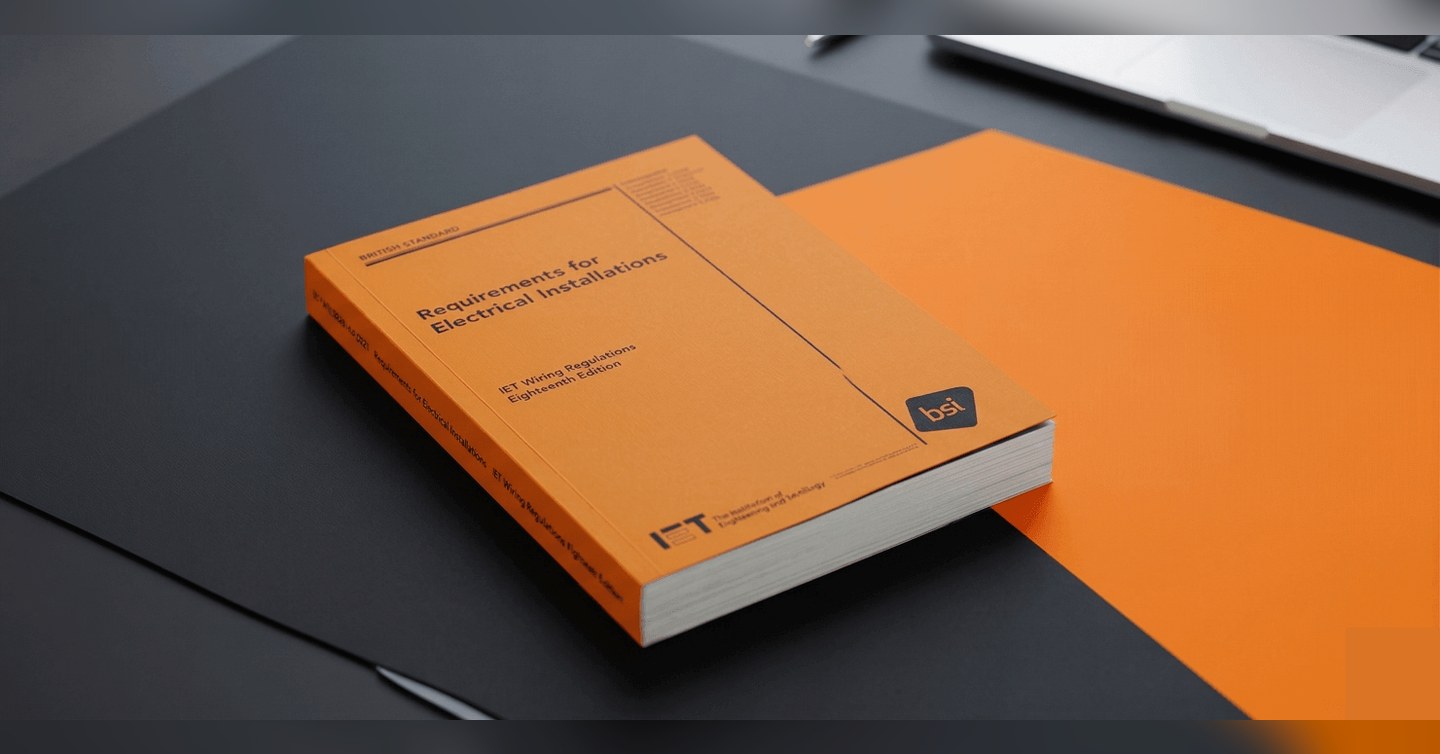
15 October 2026: the previous version (BS 7671:2018+A2:2022 with A3:2024) withdrawn.
After 15 October there is no choice of edition. New certificates and reports are written to Amendment 4.
What "withdrawn" actually means
The Introduction to Amendment 4 sets it out plainly:
"BS 7671:2018+A4:2026 Requirements for Electrical Installations was issued on 15th April 2026 and may be implemented immediately. BS 7671:2018+A2:2022+Corrigendum (May 2023)+A3:2024 remains current but will be withdrawn on 15th October 2026."
Two points in the same Introduction are worth knowing, because they come up with customers and on jobs that straddle the date:
- Jobs already designed to the old version. Note 1 says: "Completion of an electrical installation designed to the withdrawn standard can be subject to the contractual agreement between all parties involved." If a job was designed before the 15th and finishes after it, agree in writing which version it is being completed to.
- Older installations are not automatically unsafe. "Existing installations that have been installed in accordance with earlier editions of the Regulations may not comply with this edition in every respect. This does not necessarily mean that they are unsafe for continued use or require upgrading." That sentence matters on every EICR you write from now on.
The EICR: the changes you will feel on every report
Appendix 6 has redrafted the Electrical Installation Condition Report. Regulation 653.1 now requires the notes for the person producing the report to be taken into account, so these are not optional extras.
1. FI no longer makes a report unsatisfactory
This is the biggest single change. The Introduction says "the code FI no longer needs to be marked as unsatisfactory", and Section E of the new report form spells it out:
"Any observation classified as 'Improvement recommended' (code C3), or 'Further investigation' (code FI), is advisory and does not affect the overall assessment but should be given due consideration."
Note 12 for the person producing the report confirms the rule: "The overall assessment of the installation is to be reported as unsatisfactory where any observation is given a code C1 or C2 classification." So from 15 October:
Note 14 also tightens what FI is for: "Where further investigation is advised because the inspection has identified an issue which the inspector is unable to verify due to the extent and limitations, it is to be recorded within Section K as FI." In other words, FI is for something you could not verify within the agreed extent and limitations, not a place to park a decision you could have made.
2. Section K now has two observation tables
Observations are split. The first table is headed C1 and C2 OBSERVATION(S), and the form says "These items affect the overall assessment of the report." The second is headed C3 and FI OBSERVATION(S), and "These items do not affect the overall assessment of the report." Your customer can see at a glance which items drive the result.
3. Photos can be attached to support observations
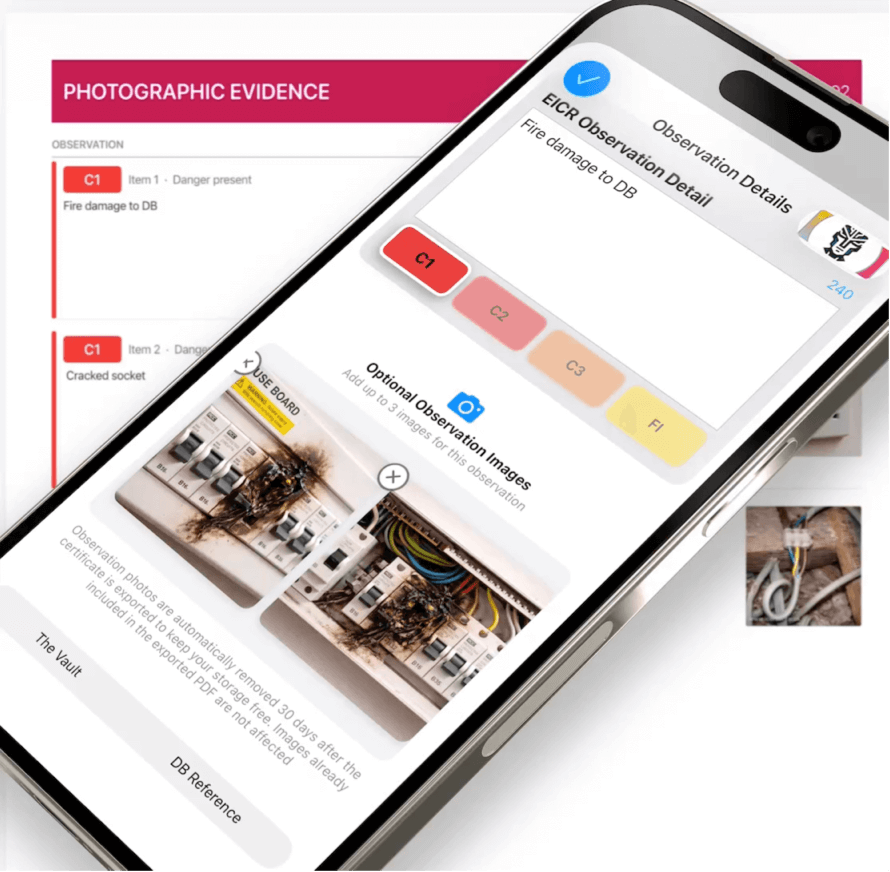
Regulation 653.2 has a new note pointing out that photographic and/or thermographic images can be appended to the report, and Section K carries the same note: "Photographic and/or thermographic images can be attached to the report to support observations made in this Section." A clear photo of a C2 does more to get it fixed than a line of text.
4. Two signatures: who tested, and who authorised
Section G (Declaration) now has two signature blocks: "Inspected and tested by" and "Report authorized for issue by". Note 10 explains that "The signatures on this Report are those of the person(s) executing the work of inspection and testing and authorizing the report for issue." If you work alone, you sign both. If a qualified supervisor signs reports off, that is now shown clearly on the form.
5. Guidance for recipients must go with the report
Regulation 653.2 now requires the report to include guidance for the recipient, based on the model in Appendix 6. The A4 guidance has 15 items, including three new instructions for the customer:
- RCDs: test six-monthly by pressing the button marked "T" or "Test", and seek expert advice if it does not switch off.
- AFDDs with a manual test facility: test six-monthly by pressing the test button, following the manufacturer's instructions where there is also an automatic test.
- SPDs: check the status indicator shows the device is in operational condition, and seek expert advice if it does not.
6. Two more notes worth reading twice
Note 1 states that the report "is only to be used for reporting on the condition of an existing electrical installation, and not for the replacement of a consumer unit/distribution board". A board change gets an EIC, not an EICR. And on the Schedule of Inspection, the intake equipment section now says: "An outcome against an item in this section, other than access to live parts, should not be used to determine the overall outcome."
Landlord reports: FI still means work to arrange
A word of caution for rented property in England. The Electrical Safety Standards in the Private Rented Sector and Social Rented Sector (England) Regulations 2020 now cover social housing as well as private lets, and they are written around work the report requires, not around the word "unsatisfactory". Regulation 3(4) says that where a report shows the landlord "is or is potentially in breach" of the duty and "the report requires the landlord to undertake further investigative or remedial work", that work must be carried out by a qualified person within 28 days, or a shorter period stated in the report.
The government's guidance for landlords puts it the same way: the regulations "require landlords to ensure that any remedial or investigative work identified in the report is completed within 28 days". That guidance was published in November 2025, before Amendment 4, and still describes FI as "Further investigation required without delay". So a satisfactory report with an FI on it can still leave a landlord with something to do. Be clear in Section K about what needs investigating, and explain the FI to the landlord or agent when you hand the report over.
EIC and Minor Works: the earthing boxes change
Regulation 312.2.1.1 now includes a figure and requirements for protective neutral bonding (PNB). On the model forms TN-C-S is now split into two boxes, so the earthing arrangement choices on the EIC (Section F) and the EICR (Section I) are:
PME remains what you will find on most public supplies. With PNB, the PEN conductor is connected to an earth electrode at a point remote from the transformer, as close as practicable to the consumer's supply terminals. The notes to Figure 3.9B say PNB can apply to single phase and three phase supplies and, on private distribution networks, "is typically used for multiple-source supplies". Check which you have before you tick.
The Minor Electrical Installation Works Certificate is now laid out in Sections A to E, and its system earthing arrangement in Section B includes both TN-C-S (PME) and TN-C-S (PNB). The EIC's Schedule of Inspections also gains a row for prosumer's low voltage electrical installation(s).
Design changes most likely to catch you out
Buried cablesThe reference methods for buried cables have been updated. Current carrying capacities now depend on whether the cable is in direct contact with soil or enclosed in a conduit or duct. Tables 4A2, 4D4A, 4E4A, 4H4A and 4J4A are revised, so recheck any SWA run to a garage, outbuilding or EV charger.
Batteries and generatorsStationary batteries have their own new Chapter 57 and are treated as a generating set, not a load. Regulation 551.7.1 now requires a suitable protective device where energy flow is bidirectional, and prohibits connecting a source to the load side of an RCD under certain conditions.
Escape routes and firefighter's switchesRegulation 422.2.1 now lists the cables permitted in protected escape routes, and cables in a fire resisting enclosure are deemed outside the route. Firefighter's switches (537.4.2) are now required where the fire engineer's fire strategy specifies them.
Conductor identificationTable 51 adds functional bonding and combined protective and functional conductors, with a note that neither "FE" nor green and yellow should be used to identify a functional bonding conductor.
Amendment 4 also brings in Section 545 (functional earthing and bonding for ICT), Section 716 (Power over Ethernet), a major revision of Section 710 (medical locations) and Chapter 81 (energy efficiency, replacing Appendix 17). Our Amendment 4 overview covers them.
Your checklist before 15 October
- Have the A4 orange book (print or digital) for reference on site
- Make sure your certificate software prints the A4 model forms, with the edition shown as BS 7671:2018+A4:2026
- Stop marking reports unsatisfactory for FI alone, and keep FI for what you genuinely could not verify
- Agree in writing which version applies on any job designed before the 15th and finished after it
- Ask the supply details: PME or PNB, rather than just TN-C-S
- Recheck buried cable sizing against the revised Appendix 4 tables
- Check what your certification scheme expects from you for the change
Amendment 4 in iCertifi
iCertifi and iCertifi Cloud Pro already produce Amendment 4 certificates: the redrafted EICR with separate C1/C2 and C3/FI observation tables, the two Section G signature blocks, observation photos, the A4 guidance for recipients, TN-C-S (PME) and TN-C-S (PNB) earthing on every certificate, and a Circuit Designer with separate buried cable methods for cables in a duct and cables laid direct in the ground. Reports you issued under the old version keep looking exactly as they did when you issued them. See what changed in the app for Amendment 4.
Quotations are from BS 7671:2018+A4:2026 (Introduction to Amendment 4 and Appendix 6) The Electrical Safety Standards in the Private Rented Sector and Social Rented Sector (England) Regulations 2020, regulation 3, and the GOV.UK guidance on electrical safety standards in the private and social rented sectors (November 2025). This guide is a summary; always refer to the full regulations.